
HISTORY OF IFC TUGS
A TRADITION THAT DEFINES GREEK LIFE AT NORTHERN ILLINOIS UNIVERSITY
No tradition defines Northern Illinois University Greek Life better than Tugs. With roots dating back more than half a century, NIU Tugs is widely regarded as one of the most unique collegiate traditions in the country. Unlike a traditional tug-of-war, teams compete from trenches in a physically demanding contest that combines strength, strategy, endurance, and brotherhood. What began as a campus competition generations ago has evolved into the signature event of NIU Greek Life and a cherished tradition for students and alumni alike.
THE CULTURAL PHENOMENON
A TRADITION BASED ON ENDURANCE
Within the terrain of American collegiate subcultures, Interfraternity Council (IFC) Tugs at Northern Illinois University (NIU) occupies a distinct and powerful territory. Spanning more than three-quarters of a century, Tugs has evolved from a lighthearted post-WWII spring festival game into an incredibly insular, physically punishing, and strategically complex athletic endeavor. To the uninitiated, it resembles a basic game of tug-of-war; to those within NIU’s Greek ecosystem, it carries a sentimental and cultural weight equivalent to high school football in the state of Texas. It functions as an institutionalized litmus test of a fraternity chapter’s collective work ethic, physical leverage, and psychological endurance, where victory guarantees campus-wide reverence and defeat carries a serious multi-generational stigma.
PHASE 1: THE MUD AND THE EAST LAGOON ERA • LATE 1940'S–1970'S
WHERE THE RIVALRY FIRST TOOK HOLD
The origin of Tugs is tied to the natural geography of the NIU campus and the seasonal rhythms of its student body.
THE POST-WAR GENESIS • LATE 1940'S
VETERANS, GREEK LIFE, AND A NEW CONTEST
In the years following World War II, a wave of military veterans flooded American universities under the GI Bill, drastically altering campus demographics. At NIU, these older, physically disciplined students revitalized the Greek life system. In the late 1940s, Tugs was introduced as an informal, high-energy competition meant to channel inter-fraternal rivalries during spring gatherings.
THE MAY FETE SHOWCASE • 1950'S
FROM SPRING FESTIVAL TO CAMPUS SPECTACLE
By the 1950s, Tugs had grown from a casual lawn game into a centerpiece attraction of NIU’s annual May Fete and Spring Fest celebrations. These early spectacles were held directly over the banks of the East Lagoon, a central body of water on campus that provided a natural, amphitheater-like setting for thousands of spectating students, faculty, and local DeKalb residents.
THE PENALTY OF THE SPLASH:
LOSING MEANT A TRIP INTO THE LAGOON
The rules during this formative era were simple and mimicked traditional playground rope pulls. Teams stood on flat, grassy terrain on opposing banks of the East Lagoon, holding a massive, thick hemp rope. The mechanics relied almost entirely on raw, upper-body pulling strength and synchronized team momentum. The losing team faced an abrupt and humiliating penalty: they were physically dragged down the slippery embankment and plunged face-first into the murky, cold waters of the lagoon, much to the delight of the cheering crowds.
THE GREAT DORM WARS • 1960'S
WHEN THE WHOLE CAMPUS CAME TO PULL
Sorority and independent student participation reached its absolute peak during the 1960s. The tournament was not yet restricted to Greek letter organizations. Large campus residence halls fielded highly competitive, massive teams based on intense floor-by-floor and building loyalties. Complexes like Gilbert Hall became buzzing hubs of Tugs culture. Furthermore, independent student clubs, commuter coalitions, and non-Greek organizations formed teams specifically to challenge the social dominance of Greek Row. For an independent team, dragging a prominent fraternity like Pi Kappa Alpha or Sigma Nu into the East Lagoon was the ultimate act of campus defiance. Because specialized training had not yet been professionalized, these matches relied on sheer workforce, rowdy crowd mobilization, and massive rosters of the largest students a dorm floor could recruit.
ORIGIN OF "HIGH BANK" VS. "LOW BANK"
A HILLSIDE ADVANTAGE BECOMES TUGS LANGUAGE
The natural topography of the East Lagoon was inherently uneven. One side of the water featured a remarkably steep, high earthen incline, while the opposing bank was lower and flatter. Pulling from the higher incline offered a massive mechanical advantage, as teams could lean backward into the hill to utilize gravity. To ensure fair play, a ceremonial coin toss or blind drawing was instituted in the 1960s to determine which team was assigned to each side. The referee's booming announcement of who drew the "high bank" and who was relegated to the "low bank" became an iconic, deeply anticipated campus ritual.
THE EVERLASTING CATCHPHRASE
TWO WORDS THAT OUTLIVED THE LAGOON
Decades later, even though modern Tugs matches are played on completely flat athletic fields, announcers still ceremonially declare "high bank" and "low bank" before every single match as a direct, sacred nod to the muddy 1960s lagoon battles.
PHASE 2: THE TRENCH REVOLUTION AND RELOCATION • 1980'S–1990'S
LEVERAGE: THE NEW PARADIGM SHIFT
The transition of Tugs from a festive campus game to a grueling, militaristic sport was driven by a single mechanical innovation and a shifting regulatory environment.
THE TRENCH REVOLUTION • 1982
SIX INCHES OF DIRT CHANGED EVERYTHING
The sport's trajectory changed forever when competing fraternities abandoned the tradition of pulling on flat grass. Trying to maximize their leverage against the rope, chapters began digging a series of two-by-two-foot, six-inch-deep trenches for each team member. This structural change radically changed the physics of the sport. Instead of relying on arm strength, "tuggers" could now completely wedge their lower bodies into the earth, locking the rope against their frames and turning their entire body weight into a dead, immovable anchor. The sport instantly transformed from a quick game of momentum into a brutal, claustrophobic war of attrition and lever mechanics that could last for agonizing stretches.
THE BAN ON INDEPENDENTS • EARLY 1980'S
THE PITS BECOME A GREEK-ONLY ARENA
The introduction of trenches led to a significant athletic disparity on campus. While fraternities began treating Tugs as a year-round, varsity-level pursuit—developing complex systems of leverage and conditioning—independent student clubs and residence halls continued to view it as a casual weekend activity. When unconditioned independent teams attempted to pull against highly organized fraternity lines, the mechanical forces of the trenched rope caused catastrophic injuries, including severe muscle tears, joint dislocations, and horrific rope burns. To reduce immense legal liability and ensure student safety, the Northern Illinois University administration and the IFC restricted the tournament to official Greek organizations, permanently banning dorms and independent clubs from entering the pits.
THE NOMAD YEARS AND CAMPUS EXPULSION • 198O'S
FROM THE LAGOON TO FIELDS ACROSS DEKALB
The escalating physical violence of the sport, paired with massive, rowdy crowds rushing the banks of the East Lagoon and creating property damage, finally forced a university crackdown. Citing severe safety hazards, the university banned Tugs from the East Lagoon. The tournament entered a nomadic era, forced completely off-campus into the DeKalb community and onto private Greek Row properties. In 1986, matches were famously hosted in the backyard of the Sigma Phi Epsilon house, later migrating to empty fields along Edgebrook Drive, before the IFC successfully negotiated a return to university property at the strictly regulated East Tailgate Field of Huskie Stadium.
THE RISE OF THE PIKE EMPIRE
THREE DECADES OF RELENTLESS PIKE CONTROL
Throughout the 1980s and early 1990s, Pi Kappa Alpha (Pike) established the most dominant and feared dynasty in the sport's history. Pike turned Tugs into a science, utilizing their massive alum network to fund specialized training equipment and enforcing a terrifyingly disciplined culture within their active chapter. Over 33 years, Pike captured a staggering 28 championships, including a legendary 8-year consecutive winning streak during which they were considered completely invincible.
THE LEGENDARY 1995 UPSET
THE MATCH THAT BROKE AN EMPIRE
By the mid-1990s, Pike's chokehold on the sport seemed unbreakable. However, the brothers of Delta Upsilon (DU) spent years quietly engineering a highly specialized training regimen explicitly designed to dismantle Pike’s leverage mechanics. In the historic 1995 championship final, DU executed a brilliant, stifling defensive strategy. Instead of wasting energy attempting to execute explosive forward surges against Pike's initial burst, DU perfectly locked themselves into their trenches, absorbing Pike's momentum and letting the reigning champions completely exhaust their physical reserves. As Pike's rhythm fractured from fatigue, DU launched a continuous counter-surge, systematically breaking Pike’s lines and winning the match. The upset was a cultural earthquake on Greek Row, shattering a historic empire and propelling Delta Upsilon to back-to-back titles.
1996 TUGS UNITED
AN INSIDE LOOK INTO THE PRESSURE OF TUGS
The immense psychological fallout and systemic desperation surrounding the 1995 upset became the core subject of the 1996 documentary film Tugs Untied. The 37-minute independent film focused heavily on the 1996 Pike chapter as they attempted to redeem their fraternity's legacy. It captured the overbearing, immense pressure placed on college students by powerful Pike alumni who had never experienced a Tugs loss in their lifetimes. The film provided an unvarnished look at the physical scars, profound exhaustion, tears, and borderline obsession of the subculture, ultimately winning "Best of Arizona" at the 2000 Arizona International Film Festival and cementing the sport’s legacy in underground pop culture.
PHASE 3: MODERN STANDARDIZATION AND SEASONAL SPLITS • 2000'S–2020'S
NEW RULES • NEW POWERS • NEW CHAMPIONS
In the new millennium, Tugs transitioned into a highly structured, heavily regulated athletic tournament defined by rotating powerhouses and expanded divisions.
THE 2000S ERA OF PARITY:
THE TROPHY STARTS CHANGING HANDS
The absolute dominance of a single fraternity gave way to fierce eras of parity. Sigma Phi Epsilon (SigEp) opened the decade by achieving a dominant "three-peat" championship run. As the decade progressed, the "Skulls" of Phi Kappa Sigma and the brothers of Phi Sigma Kappa emerged as elite powerhouses, formulating sophisticated new pulling methods that kept the championship trophy in constant motion across Greek Row.
THE SIGMA NU CATALYST • 2007
A ROUGH DEBUT SPARKS A COMPLETE REBUILD
Following their chapter's campus recolonization in 2006 with a meager roster of 16 members, Sigma Nu (Theta Eta chapter) entered the Spring 2007 Men's Tugs tournament with zero prior experience. Completely unconditioned and structurally outmatched, they were soundly defeated, losing every single match they pulled embarrassingly. Rather than abandoning the sport, this total public failure catalyzed a decade-long cultural overhaul. Sigma Nu began meticulously reconstructing their training protocols, building a system designed to replicate the indefatigable work ethic and flawless leverage of the historic 1980s Pike teams.
PHI SIG DOMINANCE • 2010'S
A DECADE SHAPED BY PHI SIG
The 2010s were largely defined by Phi Sigma Kappa's (Phi Sig) dominance. They captured multiple championships throughout the decade, maintaining an elite, highly disciplined pipeline of athletes that spanned three distinct generations of active brothers.
THE PANDEMIC DISRUPTION • 2020
FOR ONE SPRING, THE PITS WENT QUIET
For the first time since its post-WWII inception, the Tugs tournament faced a mandatory, full cancellation due to the global COVID-19 pandemic, leaving the pits empty and forcing chapters to maintain their training traditions in isolation.
THE SIGMA NU JUGGERNAUT • 2021-2024
FOUR STRAIGHT TITLES RESET THE STANDARD
Emerging from the pandemic campus closures, Sigma Nu's decade of structural preparation culminated in absolute dominance. They executed a historic four-consecutive championship run (2021, 2022, 2023, 2024), establishing the longest consecutive winning streak witnessed on Greek Row in over twenty years and firmly securing their status as the modern dynasty of the sport.
PHI PSI'S BREAKTHROUGH • APRIL 2025
PHI PSI ENDS THE SIGMA NU RUN
Seeking a historic, era-defining 5-peat in April 2025, Sigma Nu’s lines were unexpectedly fractured during a grueling bracket match. Seizing the opportunity, the brothers of Phi Kappa Psi broke through the competitive field, executing a flawless tournament run to claim the 2025 Men's Tugs Championship in a dominant grand finale victory over Delta Chi.
THE PANHELLENIC POWERHOUSE LANDMARK • FALL 2025
WOMEN'S TUGS COMMANDS ITS BIGGEST STAGE
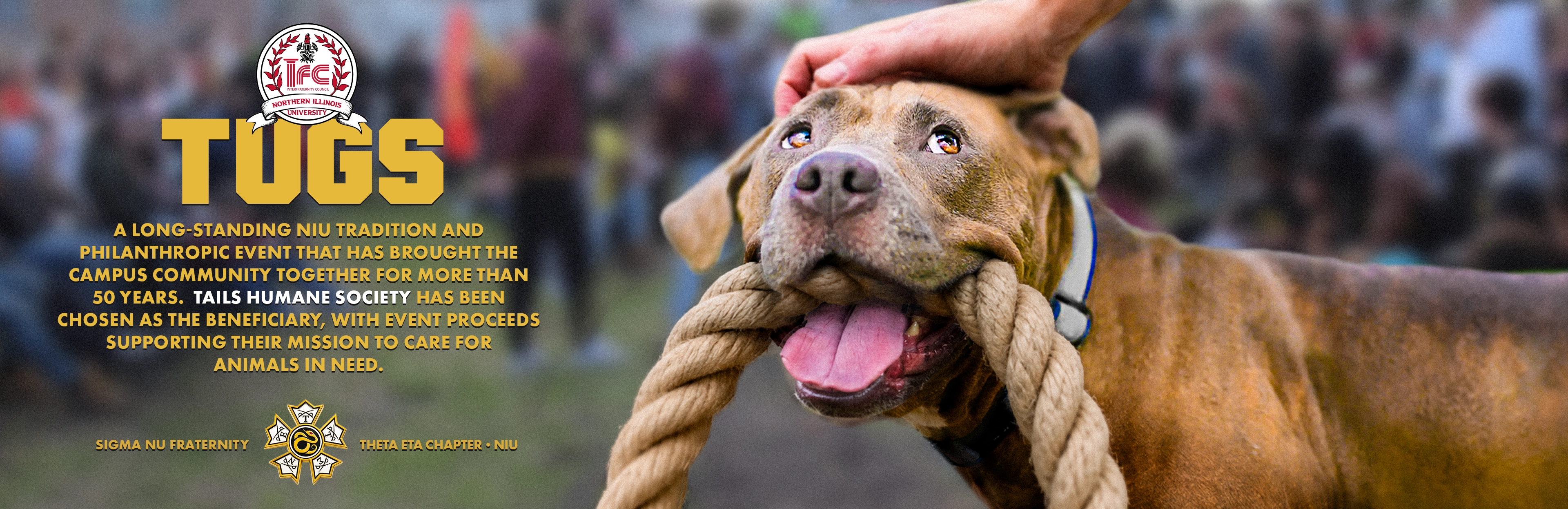
While Men's Tugs dominated the spring, Women's Tugs—strictly organized by the Panhellenic Council—claimed its own historic milestone in the Fall of 2025. Sorority teams committed to the same 14-week grueling winter and summer training schedules as the men, building identical wooden practice trenches and mastering advanced hand-locking grips to withstand thousands of pounds of rope tension. The Fall 2025 tournament drew the largest spectator turnout and highest fundraising yield in the history of the women's division, culminating in an epic, multi-hour final match that raised over $12,000 for the Kishwaukee Special Recreation Association (KSRA) to fund local Special Olympics and summer camp programs.
MODERN REDEMPTION • APRIL 2026
SIGMA NU TAKES BACK THE ROPE
Sigma Nu returned to the trenches of the East Tailgate Field with a strong resolve to reclaim their throne. In the opening rounds of the April 2026 tournament, they physically overpowered their opponents, dragging the rope's center knot into their first trench just 19 minutes into play. Advancing to the grand finals against a highly resilient Delta Chi squad, Sigma Nu used an unyielding, crushing cadence to wear down their opponents, officially reclaiming the Men's Tugs Championship title and capturing their 5th championship within 6 years.
PHASE 4: ANATOMY OF THE MODERN SPORT
HOW A TUGS LINE ACTUALLY WORKS
Modern NIU Tugs is dictated by a strict system of standardized rules, physiological preparation, and highly specialized roster execution.
THE CALLERS
THE VOICE THAT CONTROLS THE LINE
Callers do not physically touch the rope. Stationed directly alongside the dirt trenches, they serve as the team's tactical brains. A caller must possess an expert understanding of physics and leverage Studit to analyze the opposing team's body posture, rope tension, and breathing patterns. They scream highly specific, rhythmic commands to synchronize the exact micro-second their entire 10-man line executes an explosive forward "heave" or digs deep to hold defensive ground.
THE ROPE MEN • 1ST & 2ND ROPE
LOCKING BODY, ROPE, AND LEVERAGE TOGETHER
These are the individual athletes stationed sequentially inside the trenches. Tuggers do not simply hold the rope with their hands; they use a highly painful, specialized technique in which they "pinch" and lock the heavy rope tightly against their ribs and underarms, using their entire upper torso as a clamp. When the caller orders an advance, the front rope men must execute a coordinated leg-drive to push out of their trench.
REELING
THE SPRINT THAT KEEPS THE LINE MOVING
When the caller orders an advance, the front rope men must execute a coordinated leg-drive to push out of their trench. Once a forward trench is successfully won, the last rope man at the very back of the line must "reel" himself off the rope, sprint at full speed to the front of the line, and drop instantly into the next forward dirt trench to maintain forward momentum.
THE ANCHOR
THE LAST MAN HOLDING THE LINE
Positioned at the absolute end of the line, the Anchor is traditionally the heaviest, strongest, and most physically imposing individual on the roster. The Anchor’s primary responsibility is to keep the massive rope elevated completely off the ground and perfectly taut. They act as the ultimate physical counterweight, absorbing violent, crushing surges of momentum from the opposing team and stabilizing the entire line.
SAFETY, TRAINING, AND WEIGHT CLASS REGULATIONS
THE RULES BEHIND THE PHYSICAL DEMANDS
Modern NIU Tugs is dictated by a strict system of standardized rules, physiological preparation, and highly specialized roster execution.
THE 14 WEEK GRIND
FOURTEEN WEEKS BUILT AROUND THE PIT
Preparation for the April tournament begins in the cold of January. Fraternities construct elaborate, custom wooden trenches on their chapter house properties to practice lower-body leverage, foot placement, and endurance. Furthermore, competing chapters enforce a strict, mandatory policy going completely "dry" (abstaining entirely from alcohol) for the entire spring semester to maximize cardiovascular conditioning and ensure absolute focus on the pit.
BODY ARMOR MANDATES
PADDING AGAINST ROPE, DIRT, AND FRICTION
Because a heavily tensioned rope can easily shred human skin and cause severe friction burns through standard clothing, the IFC enforces rigid protective gear regulations. Tuggers are required to wrap their torsos, ribs, shoulders, and arms in thick, multi-layered wraps of towels, heavy foam padding, and industrial athletic tape. Front-line tuggers also utilize specialized shin guards to protect their legs from being violently battered against the walls of the dirt trenches during sudden movements.
TRENCH STANDARDIZATION
EVERY INCH OF THE PIT MATTERS
To eliminate unfair mechanical advantages, the IFC perfectly standardizes the construction of the Tugs pit. Trenches must be dug to exactly two feet by two feet wide, and six inches deep into the earth. Furthermore, teams must use standardized wooden footboards firmly staked at the rear of the dirt pit to anchor their feet, preventing dangerous trench cave-ins that have historically trapped and fractured the ankles of competing athletes.
WEIGHT CAPS
BUILDING TEN MEN TO ONE NUMBER
To prevent fraternities from simply stacking their lines with massive football players, the tournament operates under a strict collective team weight cap (historically fixed between 1,500 and 1,600 total pounds for the 10-man active pulling lineup). Coaches have to strategically balance their roster, deciding whether to pair a few ultra-heavyweights at the Anchor and front-rope spots with incredibly lean lightweights in the middle, or field a uniform team of mid-weight athletes.
WRESTLING STYLE WEIGHT CUTS
MAKING WEIGHT BEFORE MAKING THE LINE
Roster members undergo strict dietary management and intense, wrestling-style water weight cuts to pass the official IFC scales days before the tournament, where missing weight by a single ounce results in immediate team disqualification.
THE 20-MINUTE CAP & CENTER KNOT RULE:
WHEN INCHES DECIDE THE WINNER
In the unregulated early eras, Tugs matches could last indefinitely until one side suffered complete physical collapse. Modern safety rules strictly cap matches at 20 minutes. A brightly colored alignment knot is tied directly into the center of the rope. If neither team successfully drags their opponent completely out of the trenches by the time the 20-minute buzzer sounds, judges measure the position of the center knot. The team that has pulled the knot closest to their side of the pit by even a fraction of an inch is declared the victor.
THE ALUMNI NETWORK
PREPARATION • DISCIPLINE • SUSTAINED EXCELLENCE
Modern Tugs functions as an unofficial, massive "Spring Homecoming" for Northern Illinois University. Hundreds of alums travel across the country back to DeKalb every April, setting up elaborate, sprawling tailgate villages surrounding the East Tailgate Field of Huskie Stadium. Former champions from the 1980s, 90s, and 2000s act as consultant coaches, passing down highly guarded, multi-generational secrets regarding trench mechanics, rope-pinching angles, and caller cadences to the active undergraduate brothers. To maintain this multi-generational bond, the tournament features highly anticipated "Old Timers" exhibition matches, where older alumni tape up their arms and drop back into the trenches to battle rival alumni chapters. Alums also serve as the vital financial backbone of the sport, funding high-grade ropes, athletic gear, and trench materials, while driving the massive charitable donations that allow NIU Tugs to raise over $10,000 annually for local DeKalb organizations like the Hope Haven homeless shelter.
THE ORACLE OF THE PIT
KEVIN KEDZIOR'S "TUGS PREDICTIONS" AND COMMENTARY
THE "TUGS PREDICTIONS"
BRACKET ANALYTICS AND MORE
Just as collegiate football relies on analysts to break down film, the weeks leading up to the April tournament feature Kedzior’s highly anticipated, public "Tugs Predictions" Facebook. Pulling from over 30 years of observation, chapter oversight, and mechanical knowledge, Kedzior breaks down the bracket match-ups. He analyzes everything from roster weight distribution and caller cadences to the psychological stability of the active chapters. His predictions are viewed on Greek Row as the definitive pre-tournament standard, generating massive hype, locker-room motivation, and intense debate across campus.
THE VISION IS CLEAR
AN OFFICIAL "SPRING HOMECOMING"
Kedzior has used his platform to advocate for the official institutional expansion of Tugs. Recognizing the massive volume of returning Greek alumni, he has pushed the university to formalize the April tournament into a full-scale "Spring Homecoming" festival MyNIU. His vision includes the expansion of official university beer gardens, live entertainment, and localized food trucks surrounding the stadium tailgate fields to transform a regional tournament into a massive, revenue-generating collegiate spectacle MyNIU.
PRESERVING THE "SPORT STANDARD"
9-VS-9
As a lifelong chapter advisor and recipient of the university's 2024 Chapter Advisor of the Year award, Kedzior acts as a strict traditionalist LinkedIn. Through historical breakdowns (famously cataloging classic matches like the 1989 SigEp vs. Phi Sigma Kappa war), he regularly educates active undergraduates on the physics of the original sport Facebook. He remains an outspoken advocate for the historic "Sport Standard" - reminding the campus that while modern 7-vs-7 variations are highly athletic, the true apex of Tugs lies in the massive, crushing endurance of the historic 9-vs-9 trench lines Facebook.
ALUMNI TUGS MOBILIZATION
MENTALLY • PHYSICALLY • FINANCIALLY
Kedzior functions as the primary bridge connecting multiple generations of disparate Tugs alumni. By documenting and publicizing historical match data, recording veteran interviews, and maintaining digital forums, he translates nostalgic pride into direct financial support. Under his mobilization efforts, older alumni are continuously integrated back into active chapter operations as donors and technique consultants. This active engagement keeps the pipeline of equipment funding alive, directly ensuring that undergraduate chapters have the high-grade materials required to safely maintain the sport's high physical standard.
PHASE 5: THE FUTURE OF TUGS
KEEPING THE PITS STRONG FOR WHAT'S NEXT
As Tugs marches deeper into the late 2020s, the future of this historic tradition rests on a fine balance between preserving its legendary, unvarnished intensity and adapting to a rapidly changing collegiate landscape. The sport has increasingly secured its longevity by leaning into its function as a premier philanthropic showcase for the university. The immense fundraising milestones achieved during the 2025 and 2026 tournaments have demonstrated to university administrators that the Tugs event is a highly effective vehicle for positive community impact, directly assisting vital local resources such as Hope Haven and the Kishwaukee Special Recreation Association.
Structurally, the Interfraternity and Panhellenic Councils continue to reevaluate safety procedures annually. Advances in specialized athletic tape technology, refined body-padding requirements, standardized pit engineering, and mandatory on-site medical oversight ensure that, while the 14-week "dry" grind and immense physical toll remain completely unchanged, the risk of catastrophic, career-ending injury is carefully mitigated. Furthermore, the explosive growth and soaring attendance of the Women's Tugs tournament in the fall suggests a highly sustainable, inclusive expansion of the sport. By sharing equal cultural footing with the historic spring men's bracket, Tugs has transitioned from an insulated fraternity relic into an all-encompassing, campus-wide phenomenon. Backed by a fiercely loyal, nationwide alum network that funds equipment and preserves generational techniques, the mud-filled trenches at the Huskie Stadium East Tailgate Field are set to remain a defining, legendary element of Northern Illinois University's identity for generations to come.
WE WELCOME YOU TO LEARN MORE
THETA ETA CHAPTER • NORTHERN ILLINOIS UNIVERSITY
Since our first annual Commander’s Dinner in 2020, Theta Eta has proudly recognized its outgoing and incoming Eminent Commanders while celebrating the achievements of undergraduate members and distinguished alumni who continue to serve our great fraternity. The Commander’s Dinner highlights our chapter’s strong leadership culture, honors lasting brotherhood, and serves as an annual reunion open to all alumni, attracting men from across the country to gather, reconnect, and celebrate the enduring legacy of Theta Eta.